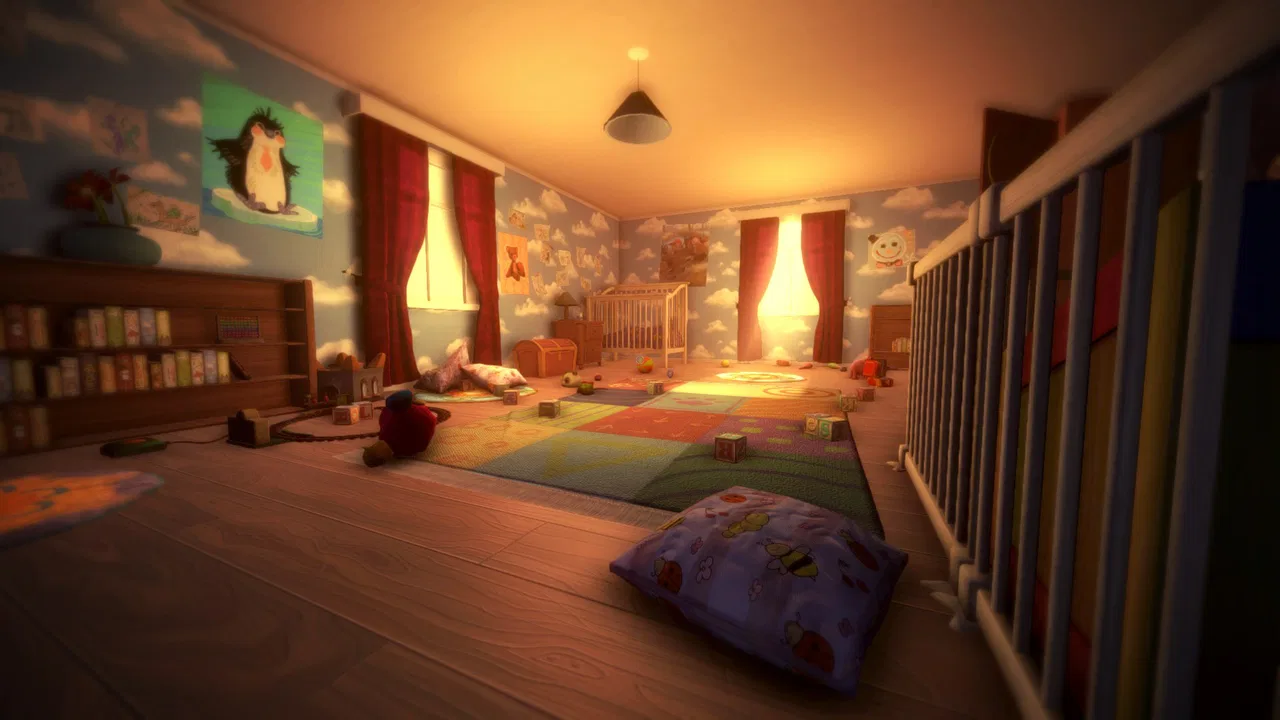
Among the Sleep
- 4.6
- Rating
- 100.00K
- Installs
- Free
- Price

 Analysis by App-foxy
I approached Among the Sleep expecting a compact adventure game, but its central idea is more unsettling than that label suggests. You leave the safety of a bed and move through a warped nighttime world where ordinary surroundings feel unfamiliar. That setup gives the game a strong emotional hook: the danger is not just somewhere far away, but close to the places that should feel most comfortable. After spending time with it, I see it as a focused choice for players who prefer atmosphere, exploration, and unease over constant action.
Snapbreak presents the game as a free adventure title for mobile, with a Teen content rating. It has reached over one hundred thousand installs and holds an average of 4.4 from roughly two thousand ratings, which suggests that the unusual premise has connected with a respectable audience. The current release is version 1.0.0.0.5, and the game runs on devices using Android 7.1 or later. Those details matter because this is not positioned as a huge, endlessly expanding platform; it feels more like a contained experience that asks whether you are willing to follow its strange nighttime journey.
A closer look at the nighttime adventure
I find it useful to approach this nighttime adventure with a small plan rather than treating each session as a quick mobile distraction. I’ll focus on how to settle into its exploratory pace, make practical choices that protect the atmosphere, and build a repeatable way to pick up where I left off. That sets up a closer look at which habits help—and where careful play still cannot remove the game’s deliberate uncertainty.
You May Also Like

 AccuWeather: Weather Radar
AccuWeather Review: A Quick, Clear Forecast for Everyday Decisions
For everyday plans, the best forecast is the one you can understand quickly. AccuWeather makes rain timing, radar, and local conditions easy to act on, with a few trade-offs.

 Hill Climb Racing
Why Hill Climb Racing Still Turns Crashes Into One More Run
A tiny car, a bumpy hill and one more upgrade: Hill Climb Racing keeps resurfacing because its simple chaos makes every near-miss feel personal.

 AliExpress - Shopping App
AliExpress Makes Global Shopping Feel Personal, but Shoppers Bear the Risk
AliExpress turns a global marketplace into a pocket-sized discovery engine. Its reach is useful, its shopping loop compelling, and its trade-offs easy to miss.

 Lords Mobile: Kingdom Wars
Lords Mobile Is a Kingdom-Building Routine, Not a Quick Match
A case-by-case verdict on the building, battles, device demands, and social commitments that make Lords Mobile rewarding for some players and exhausting for others.

 PDF Scanner app - TapScanner
TapScanner Makes Paperwork Easier to Capture, Check, and Share
TapScanner makes scanning with a phone feel less like a rescue operation and more like a dependable step in getting work done. Its capture tools are useful, though not flawless.

 Block Blast!
 Shows How Much a Puzzle Game Can Leave Out
A quiet grid game shows why puzzle players increasingly value instant clarity, repeatable skill and low-pressure play—and where the genre still needs to catch up.
More From Our News Desk
View All News


The opening idea creates immediate tension
The most effective part of the concept is the contrast between vulnerability and exploration. A bed normally represents rest, routine, and protection. In this game, leaving it becomes the first step into uncertainty. I found that reversal more memorable than a standard horror setup because it makes familiar spaces feel suspicious. A hallway, a room, or a shadow can carry more weight when the player is already thinking about the safety they left behind.
The experience is built around finding safety in a distorted world rather than simply defeating enemies. That distinction changes how I played. I was more interested in reading the environment, checking possible routes, and deciding whether moving forward was worth the risk than in rushing toward a fight. Players who enjoy atmospheric adventures will probably appreciate that slower rhythm. Anyone looking for a combat-heavy game, a score-chasing arcade loop, or quick competitive matches should look elsewhere.
The game’s strongest moments come from uncertainty. I was not always sure whether a strange visual detail was important, a warning, or simply part of the dreamlike setting. That ambiguity encourages attention, but it can also create friction. If you prefer clear objectives and constant guidance, the deliberately uneasy presentation may feel vague rather than intriguing.
Why the mobile format suits the idea
On a phone, a short atmospheric adventure can fit naturally into an evening routine. I can imagine playing it with headphones while the house is quiet, giving the environmental sounds and visual changes more room to work. It is less suitable for a distracted commute or a noisy waiting room, where the tension would be interrupted and the careful mood would lose much of its effect.
A realistic use case would be a player who has half an hour after dinner and wants something more distinctive than another match-based game. This is the kind of title I would open when I want to explore a fictional place and absorb its atmosphere, not when I want to fill every spare minute with repeatable tasks. The free entry point also makes it easier to test that mood before deciding whether the experience deserves more of your time.
There is a trade-off here. A mobile screen can make the world feel intimate, but it can also make subtle details harder to read, especially if the device is small or the room is brightly lit. I had a better experience when I increased my attention to the display and avoided playing while multitasking. That sounds simple, but it is important for a game whose impact depends on noticing changes in a familiar-looking environment.
Exploration is more important than speed
I recommend resisting the urge to sprint through the early sections. The game’s appeal depends on the relationship between movement and discovery, so rushing can make the world seem emptier than it really is. I found it more useful to pause at transitions, look back after entering a new area, and remember where I had already been. This is not just a way to stretch the session; it helps preserve the feeling that the environment is changing around the player.
One practical tip is to treat every apparent safe point as a moment to reorient rather than an invitation to relax completely. The game’s premise makes comfort feel temporary, and that expectation improves the atmosphere. Another useful habit is to play in short, uninterrupted sessions. Stopping in the middle of a tense sequence and returning much later can weaken the emotional continuity, while a focused session lets the visual and narrative details build on one another.
This approach also reveals one of the game’s limitations. Players who prefer explicit maps, generous checkpoints, or a strong objective marker may find the exploration less convenient than in more traditional adventure games. The uncertainty is part of the design appeal, but it is not equally enjoyable for everyone. I would not recommend it to someone who becomes frustrated whenever a game asks them to interpret a space instead of following a prominent route indicator.
What the current release tells us
The current version, 1.0.0.0.5, gives the game a defined starting point for mobile players. I treated it as the version to judge today rather than assuming that future updates will reshape the experience. That is important with a relatively focused adventure: a later patch might improve convenience or presentation, but it would be unfair to recommend the game based on features that are not currently part of the release.
For existing users, the current state is best understood as a polished entry into the game’s core idea rather than a reason to expect a completely different structure. If you already enjoy its unusual atmosphere, the update number does not change the basic recommendation: return when you can give the game your full attention. If you stopped playing because the pacing or ambiguity did not suit you, a version label alone is not a reason to assume that the fundamental experience has become a conventional action adventure.
The release also helps set expectations for new players. You are not buying into a complicated live-service routine with daily obligations. You are trying a free adventure from Snapbreak that is centered on a specific nighttime premise. That makes the decision fairly straightforward: install it if the idea of navigating a distorted world appeals to you, and skip it if you need repeatable progression, social play, or a clearly competitive goal.
Free access and the role of purchases
The game is free to start, but in-app purchases are listed at $5.99 per item. I see that as a reason to approach the opening with a clear expectation: free access lowers the barrier to trying the adventure, while the purchase structure may matter if you decide you want additional access or convenience during your time with it. I would not spend immediately. First, I would test whether the movement, tone, and exploratory pacing work for me.
This is especially sensible because atmosphere is personal. A strong premise cannot guarantee that every player will enjoy the way the game delivers it. Some people will be drawn in by the dreamlike unease, while others will find the slow tension uncomfortable or the lack of direct action too restrained. Trying the free version before making a purchase is the most practical way to judge that difference.
If you are considering the game for a younger player, the Teen rating should be part of the decision. The setting deals in fear and vulnerability, so I would not treat it as a general children’s bedtime game simply because the central image involves a bed. For adults and older teenagers who enjoy suspenseful exploration, the rating feels like a useful warning to expect a more unsettling experience than a light family adventure.
How it compares with familiar alternatives
Compared with action adventures, this game places less emphasis on fighting and more on the emotional effect of the environment. That makes it a better fit for someone who enjoys walking through strange spaces, noticing details, and letting tension develop gradually. A conventional action title will usually provide clearer goals and more immediate feedback, so it is the better alternative if you want frequent encounters and a strong sense of power.
Compared with puzzle-focused adventures, the appeal here is not only solving a problem. The setting itself is part of the challenge because it keeps asking you what can be trusted. A puzzle game may reward precise logic above all else, while this experience rewards patience and observation. If you enjoy arranging clues but dislike suspense, a calmer mystery game would probably suit you better.
It also differs from endless mobile games. There is no reason to approach it as a title that should occupy every day through repeated rounds. Its value comes from the mood of the journey and the curiosity to see what the distorted world is hiding. That makes it easier to recommend to someone tired of energy timers, repetitive missions, and constant notifications, but harder to recommend to a player who needs long-term replayability from every download.
Small habits that improve the experience
I would begin with headphones and a comfortable screen brightness, but I would avoid making the room completely dark if that causes eye strain. The point is to support concentration, not to create an unpleasant physical setup. Sound and visual contrast matter more here than they would in a bright, fast-paced game, because the atmosphere depends on the player noticing gradual changes.
I would also avoid reading a detailed walkthrough before starting. Guidance can be useful if you become genuinely stuck, but discovering the logic of the world is part of the reward. If you consult help too early, you may solve the immediate obstacle while losing the tension that makes the obstacle meaningful. My preferred workflow is to explore carefully, retrace my steps once, and only then look for assistance.
Another non-obvious advantage of short sessions is memory. When I play while the details are still fresh, I remember visual landmarks and the emotional tone of a location. That makes returning to the game easier than restarting after a long gap. If you have limited time, two focused sessions are likely to work better than several interruptions where you keep forgetting what felt important.
Where the experience may fall short
The same restraint that gives the game its identity can limit its appeal. Players who want extensive character development, a broad inventory, or a large open world may finish a session wishing there were more systems to master. This is not a criticism of the premise itself; it is a reminder that the game’s priorities are atmosphere and discovery rather than depth in every conventional adventure category.
The free model may also influence how you judge the experience. Even when the core mood works, any purchase prompt can interrupt the feeling of being absorbed in the world. I would rather decide about spending outside a tense moment, so I can evaluate the game on its actual enjoyment instead of reacting to the pressure of wanting to continue immediately.
Device compatibility is another practical point. Android 7.1 is the minimum operating system, so older phones may not be eligible even if they can handle other simple games. On a compatible device, I would still close unnecessary apps before playing and keep enough storage available for a smoother installation and session. Those are ordinary precautions, but atmospheric games suffer more when technical interruptions break the mood.
What I would watch from here
For future development, I would pay attention to whether Snapbreak improves convenience without weakening the uncertainty that defines the adventure. Better onboarding, clearer accessibility options, or smoother device support could help newcomers without changing the core tone. On the other hand, too much explanation or excessive guidance could make the world feel less mysterious, so any evolution needs to preserve the balance between confusion and curiosity.
I would also watch how the game serves players who finish the main journey. A focused adventure does not need endless content to be worthwhile, but replay value, thoughtful extras, or meaningful refinements could make the free release more attractive over time. I would prefer additions that deepen the setting rather than turn it into a routine-based mobile game with repetitive tasks.
Existing players should judge future changes by their effect on immersion. A technical improvement is valuable if it removes distractions; it is less valuable if it adds layers that pull attention away from the nighttime world. New players, meanwhile, should make their decision based on what is available now: a free, Teen-rated adventure with a distinctive premise, a current version of 1.0.0.0.5, and optional purchases priced at $5.99 per item.
My recommendation for the right player
I would recommend Among the Sleep to anyone who enjoys unsettling exploration, dreamlike environments, and games that make ordinary places feel emotionally charged. It is a particularly good choice when you want a self-contained-feeling adventure rather than a competitive distraction. The free starting point makes experimentation easy, and the strong average rating shows that its central style has found an audience.
I would skip it if your priority is fast combat, cooperative play, endless progression, or highly explicit navigation. I would also be cautious if you are sensitive to suspense or prefer games that make you feel powerful from the beginning. This title asks you to accept vulnerability and uncertainty, and that is either its biggest strength or its main barrier depending on your taste.
My final impression is positive, with a clear qualification: the game succeeds because it commits to its nighttime atmosphere, not because it tries to satisfy every type of mobile player. Snapbreak has built an adventure around the unsettling decision to leave a place of safety, and that idea gives the experience a memorable identity. Its best feature is the way it turns exploration into an emotional choice; its main weakness is that the same slow, ambiguous approach will not suit players who need constant action or precise direction.
For me, the sensible way to try it is simple: play with headphones, give it an uninterrupted session, avoid rushing, and decide about purchases only after the mood has had time to work. If that careful, uneasy journey sounds appealing, this free adventure is worth a place on your Android device.
FAQs for Among the Sleep
01What is the main storyline of Among the Sleep?
Among the Sleep is a first-person horror adventure game where you play as a two-year-old child. The game explores the fears and imagination of a young child, navigating through a surreal, dream-like world to uncover the mystery of their missing mother. It combines elements of exploration and stealth with a gripping narrative.
02Is Among the Sleep suitable for children?
While the game features a child protagonist, Among the Sleep is designed for mature audiences. It contains themes of horror, suspense, and psychological tension that may not be appropriate for young children. Parental discretion is advised due to its unsettling atmosphere and mature themes.
03How long does it take to complete Among the Sleep?
Among the Sleep is a relatively short game, typically taking around 2 to 4 hours to complete. The length can vary depending on the player's pace and how much they explore the environment. The game is designed to deliver a concise yet impactful experience within a short timeframe.
04What platforms is Among the Sleep available on?
Among the Sleep is available on multiple platforms, including Android, iOS, PC, PlayStation, and Xbox. This wide availability ensures that players can enjoy the game on a variety of devices, making it accessible for those who prefer mobile gaming or console experiences.
05Are there any special features in the enhanced edition of Among the Sleep?
The enhanced edition of Among the Sleep includes improved graphics, better performance, and additional content. It also offers enhanced sound design, new dialogue, and interactive elements that enrich the overall experience. This edition provides a more polished version of the original game, enhancing immersion for players.
Pros
- Engaging and unique horror experience.
- Creative use of a child's perspective.
- Atmospheric sound design enhances tension.
- Simple controls suitable for all ages.
- Immersive story with emotional depth.
Cons
- Limited replay value after completion.
- Graphics may seem outdated to some.
- Short gameplay duration.
- Pacing can feel slow at times.
- Lack of challenging puzzles.

Among the Sleep
Gallery